
You’ve been burned by marketing agencies before. You’re tired of the endless retainers, the black box processes, and the vanity metrics that never translate to actual revenue. You know you need a change, but you’re not sure what the real alternatives to marketing agencies actually look like in practice.
This is the defining dilemma for many B2B technology founders: do you try to build a marketing function in-house, or do you risk the agency model again—knowing how that story tends to end? This is the “build vs. buy” decision, and it’s one of the most consequential strategic choices you’ll make for the future of your company.
In this guide, we’ll break down every real option available to you, expose the hidden flaws in the traditional framework, and present a third path that most founders have never considered: the Growth Architecture model. If you’re actively searching for any alternatives to marketing agencies, you deserve a complete, honest picture.

Why Most B2B Tech Founders Are Looking for Alternatives to Marketing Agencies
Before we evaluate your options, it’s worth diagnosing the root cause of the problem. Most B2B technology companies don’t fail at marketing because they chose the wrong agency or hired the wrong person. They fail because they’re treating a systems problem like a vendor problem.
They keep searching for better agencies, more talented hires, or cheaper contractors—when the real issue is that they’ve never built a coherent, owned revenue system in the first place. The result is predictable: inconsistent pipeline, over-reliance on referrals, and a perpetual feast-or-famine cycle that makes it impossible to forecast growth.
 The Referral Trap
 The Referral Trap
Most B2B tech firms grow to $1M–$5M almost entirely on referrals and founder relationships. This feels like traction, but it’s actually a fragile dependency. Referral pipelines are unpredictable, non-scalable, and nearly impossible to systematize. When the referrals slow down—and they always do—there’s no engine to replace them.
This is the moment founders start hunting for alternatives to marketing agencies that already burned through their budget, or scrambling to hire their first marketing person without a clear mandate for what that person is supposed to build.
Why Past Agency Relationships Failed
The typical agency relationship fails for structural reasons, not personal ones. Most agencies are optimized to run campaigns—not to build systems. They measure success in clicks, impressions, and MQLs. You measure success in revenue. These incentives are fundamentally misaligned.
When you stop paying the retainer, the campaigns stop. The ad creative disappears. The SEO work gets handed to the next client. You own nothing. You’ve been renting marketing services, not building a marketing asset. This is the core argument for exploring real alternatives to marketing agencies: you need something you can own.
The Flaw in the Traditional “Build vs. Buy” Framework
The traditional “build vs. buy” framework presents a false binary. “Building” is framed as hiring a full-time marketing team—a slow, expensive, high-risk process that can take 12–18 months to show results. “Buying” is framed as outsourcing to a tactical agency—fast to start, but structurally incapable of delivering what you actually need.
Both options have real merit in the right context. But the problem is that most founders are being forced to choose between them without ever being shown a third option. The framing itself is limiting.
What if you could buy the expertise to build the system yourself? What if you could engage outside expertise for a defined period, transfer complete ownership of the result, and never depend on that vendor again? This is the fundamental premise behind the Growth Architecture model—and it’s the most powerful of the alternatives to marketing agencies that most founders have never encountered.
The Three Real Alternatives to Marketing Agencies
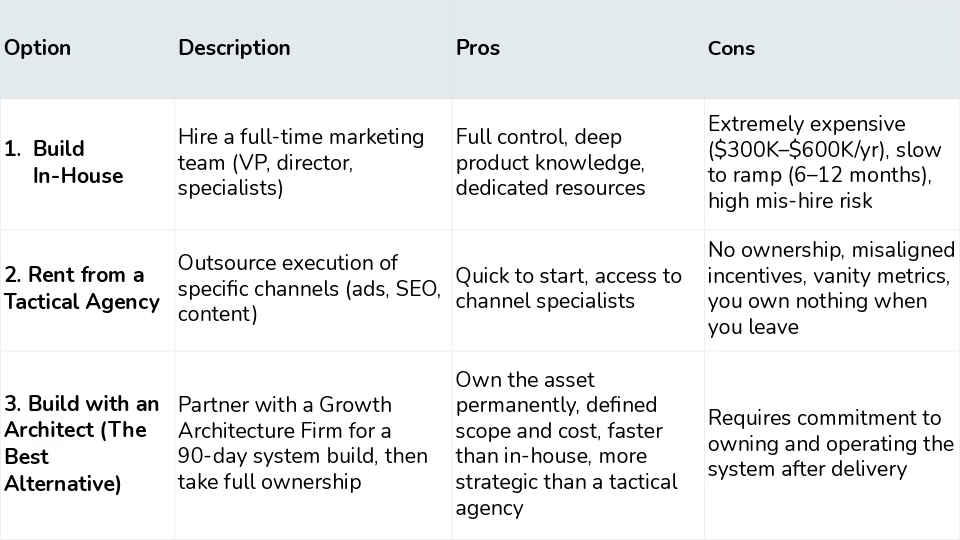
Let’s break down your three genuine options with complete honesty—including the tradeoffs most vendors won’t tell you about.
A Deeper Look at Each Option
Option 1: Build In-House
Building in-house means hiring one or more full-time marketers to own your growth function internally. Done well, this is the gold standard for long-term scalability. Your team knows your product, your customers, and your competitive positioning at a depth no outside vendor can match.
The problem is the cost and the timeline. A credible in-house marketing function requires a VP or Director ($150K–$200K), a content or demand gen specialist ($80K–$100K), and a marketing operations hire ($90K–$120K). You’re looking at $400K–$600K in fully loaded annual costs before you’ve run a single campaign—and a 6–12 month ramp-up before they’re operating at full capacity.
For a B2B tech firm doing $2M–$10M in revenue, this is often not a viable path in the short term. The risk of a mis-hire at this stage can set you back 18 months and $200K. This is why so many founders go looking for alternatives to marketing agencies that don’t require the commitment of a full internal team.
Want to benchmark what in-house marketing costs by company size? HubSpot’s Marketing Salary Guide provides a data-driven framework for planning.
Option 2: Rent from a Tactical Agency
The tactical agency model is the most common option, and the most commonly regretted. It’s fast to start, gives you access to channel-specific specialists, and feels like real momentum in the early weeks. The problem surfaces around month three or four, when the initial optimism collides with structural reality.
Tactical agencies are built to execute specific channels: paid media, SEO, content, social. They are not built to diagnose your revenue architecture, align your positioning to your buyer journey, or create the foundational infrastructure that makes all those channels work. They pick up where a strategy should already exist—and most of their clients don’t have one.
The result is activity without compounding. You get reports full of impressions, click-through rates, and traffic metrics—while your pipeline stays inconsistent and your revenue stays unpredictable. When you end the engagement, you leave with nothing tangible. This is the structural argument for finding real alternatives to marketing agencies that are built around ownership, not execution.
McKinsey’s research on B2B growth confirms that companies who invest in systematic GTM infrastructure significantly outperform those who rely on fragmented channel execution.
 Option 3: Build with a Growth Architect (The Hybrid Model)
 Option 3: Build with a Growth Architect (The Hybrid Model)
The Growth Architecture model is the third option—and in most cases, the best alternative to marketing agencies for B2B tech companies at the $1M–$20M stage. Here’s how it works: you engage a Growth Architecture Firm for a defined project engagement (typically 90 days). At the end, you own the entire system.
This isn’t a retainer. It’s not ongoing management. It’s an infrastructure build with a defined scope, a defined deliverable, and a defined end date. When the engagement concludes, the buyer journey architecture, the content engine, the email sequences, the lead scoring model, and the data infrastructure are yours—permanently.
You get the strategic depth of an experienced outside team without the long-term overhead of a full-time hire. You end up with a permanent asset instead of a pile of reports. And you never have to worry about losing momentum the moment you stop paying a retainer.
What a Growth Architecture Firm Actually Builds
The term “Growth Architecture” might sound abstract, so let’s make it concrete. When you engage a firm like Influential Agency, here’s what gets designed and built during a 90-day engagement:
- Buyer Journey Architecture: A documented, evidence-based map of how your ideal clients move from awareness to close, including the decision triggers, objections, and information needs at every stage.
- Positioning & Messaging System: A clear, differentiated market position that speaks directly to your ideal clients’ specific pain points—not a generic value proposition that sounds like every competitor.
- Content Engine: A structured content framework aligned to your buyer journey, including pillar content, supporting articles, and distribution strategy. Designed to compound over time.
- Email & Nurture Infrastructure: Automated sequences that move qualified prospects from initial contact to sales-ready conversations, without requiring manual follow-up for every lead.
- Pipeline Measurement Framework: A clear set of leading and lagging indicators tied to revenue outcomes—not vanity metrics.
According to Gartner’s B2B Buying research, B2B buyers spend only 17% of their total purchase journey meeting with potential suppliers. The other 83% is spent researching independently. If you don’t have the infrastructure to support that independent research process, you’re invisible during the most critical phase of your buyer’s decision.
Stop Renting, Start Owning: The Philosophy Behind the Alternatives to Marketing Agencies
The fundamental problem with the traditional agency model—and one of the most compelling reasons to seek alternatives to marketing agencies—is the ownership problem. You are renting their services. The moment you stop paying, the work stops. The campaigns go dark. The strategy documents stay in their Google Drive. The institutional knowledge walks out the door.
A Growth Architecture Firm operates on a fundamentally different principle: we build you an asset. Not a service. An asset. At the end of the engagement, you own the system—the architecture, the content, the automation, the data. It’s yours to operate, improve, and build upon indefinitely.
This is the shift from being a renter to being an owner. It’s the same principle that distinguishes a mortgage from a lease. The monthly cost might look similar. But at the end of one, you own something. At the end of the other, you don’t.
 Why This Model Works Especially Well for B2B Tech Firms
 Why This Model Works Especially Well for B2B Tech Firms
B2B technology companies have a unique challenge: they are selling complex, high-consideration solutions to highly educated, deeply skeptical buyers. Generic marketing tactics don’t work. Spray-and-pray advertising doesn’t work. What works is a precisely engineered system that meets your specific buyer at each stage of a long, multi-touch buying journey.
That kind of precision requires architecture, not execution. It requires a deep understanding of your buyers, your positioning, your competitive landscape, and your sales motion. It requires someone who will build that understanding into a durable system—not someone who will run your LinkedIn ads and report on impressions.
This is exactly why the Growth Architecture model has emerged as one of the most effective alternatives to marketing agencies for technical founders who have been burned by the traditional model and aren’t ready to make a $500K in-house bet.
How to Evaluate Any Alternatives to Marketing Agencies
Not every firm that calls itself a Growth Architecture Firm is actually one. If you’re evaluating your options, here are the questions that will separate genuine alternatives from agencies with a different name on the door:
- Do they lead with strategy or execution? A true alternative to the agency model starts with diagnosis—not deliverables. If the first conversation is about campaigns, channels, or content calendars, you’re talking to a tactical agency wearing strategic clothing.
- What do you own at the end? This is the most important question. Ask explicitly: “What assets do I own when we conclude the engagement?” If the answer is vague, walk away. If the answer is “everything we build,” you’re on the right track.
- Is it project-based or retainer-based? Retainer models are structurally aligned with ongoing dependency. Project models are structurally aligned with knowledge transfer and ownership. Ask which model they use and why.
- Do they have a defined framework? Legitimate Growth Architecture Firms have a documented, repeatable methodology. At Influential Agency, this is a systematic approach to building growth infrastructure that is specific to B2B technology companies.
- What does success look like at 90 days, not 90 weeks? If a firm can’t describe what you’ll have at the end of a defined engagement, they don’t have an architecture model. They have a retainer model with a different pitch.
The Decision Framework: Which Option Is Right for You?
Every B2B tech company is different. The right path depends on your current stage, your resources, and your growth trajectory. Here’s a simple framework for deciding which alternatives to marketing agencies make the most sense:
Choose Build In-House if:
- You’re at $10M+ in revenue and ready to invest $400K–$600K per year in a dedicated team
- You have a VP of Marketing with a strong track record who will own the build
- You’re willing to accept a 12–18 month ramp before seeing meaningful results
- Growth is your primary strategic priority and you have the runway to support it
Choose a Tactical Agency if:
- You need to run a specific campaign or channel immediately and have defined, measurable goals
- You already have a documented strategy and just need execution support for a specific initiative
- You understand you are renting, not building, and have made peace with that tradeoff
Choose a Growth Architecture Firm if:
- You’re between $1M and $20M and can’t justify a full in-house team yet
- You’ve been burned by agencies and want to end the cycle of renting services
- You want to own the result—not just receive a report
- You’re willing to commit to operating and improving the system after delivery
- You need a defined scope, defined cost, and defined deliverable—not an open-ended retainer
Ready to Own Your Growth?
If you’re tired of the alternatives to marketing agencies that feel like the same model with a different label, this is your off-ramp. A Growth Architecture engagement is a 90-day project with a defined scope, a defined deliverable, and a permanent asset at the end.