


The Zoom meeting ended with the usual pleasantries. “Great progress this month,” the account manager said with a smile. “We’ll send over the full report by end of day.” You nodded, thanked them, and clicked the red button.
The screen went black.
You sat there for a moment, staring at your reflection in the dark laptop screen. Your office was quiet. Too quiet. Through the wall, you could hear your sales team on a call, their voices muffled but animated. They were working a deal. A real one. One that came from a referral, not from the agency’s “50 new MQLs.”
You opened the agency’s dashboard—the one they’d just walked you through. The numbers looked impressive. Impressions were up 300% month-over-month. You had 50 new marketing qualified leads in the pipeline. Cost per lead was down 15%. The graphs were all pointing up and to the right, just like they’re supposed to.
But something felt wrong.
You minimized the dashboard and opened your CRM. You scrolled through the list of “MQLs” the agency had delivered over the past six months. You clicked on a few at random.
- Lead #1: Downloaded a whitepaper. Never responded to follow-up emails. LinkedIn shows they changed jobs three months ago.
- Lead #2: Filled out a “contact us” form. Your sales rep called. They said, “We’re not in the market right now. Maybe next year.”
- Lead #3: Attended a webinar. When your rep reached out, they didn’t even remember registering.
You closed the CRM and opened your bank account. Another $10,000 had been automatically debited this morning. You did the math in your head: six months, $60,000 total. You opened a new tab and checked your sales pipeline. Zero new opportunities from the agency’s leads. Not one.
Your chest tightened.
You leaned back in your chair and stared at the ceiling. You thought back to six months ago—the day you signed the contract. You remembered sitting in this exact chair, pen hovering over the signature line. You remembered the feeling: relief. Finally, you had a plan. Finally, you had experts who understood B2B marketing. Finally, you could stop worrying about lead generation and focus on running the company.
You signed the contract. You shook hands over Zoom. You felt like you’d just made a smart, strategic decision.
But now, six months later, you felt something very different. You felt dread. The kind of dread that sits in your stomach and doesn’t leave. The kind that wakes you up at 3 a.m. and whispers, “You’re running out of time. You’re running out of money. And you still don’t have a plan.”
You opened Slack. Your head of sales had sent you a message an hour ago: “Hey, can we talk about these leads? The team is spending hours following up and getting nowhere. Is there a way to get better quality?”
You didn’t respond. What were you supposed to say? You’d already had this conversation with the agency. They’d told you the leads were “high quality” and that your sales team “just needed to follow up faster.” They’d shown you benchmarks. They’d shown you case studies. They’d made it sound like you were the problem, not them.
Therefore, you’d started to believe them. Maybe your sales team was the problem. Maybe they weren’t following up fast enough. Maybe they weren’t good at cold outreach. Maybe, maybe, maybe.
But deep down, you knew the truth. The leads were garbage. The agency was measuring the wrong things. And you’d just wasted $60,000 and six months.
You closed your laptop. You stared at the wall.
And then, in that moment—sitting alone in your office, surrounded by the quiet hum of a company that was supposed to be growing but wasn’t—you had a realization. A five-second moment that changed everything.
“This isn’t bad luck. This isn’t the wrong agency. This is a pattern. I didn’t hire the wrong vendor… I bought the wrong thing.”
This is the Agency Death Spiral. It’s not a failure of execution. It’s a failure of strategy. And it’s the predictable result of a flawed, tactics-first model that plagues B2B tech companies.
This article will show you why it happens, how to recognize it, and—most importantly—how to break the cycle.
Chapter 1: The Siren Song of Tactics
Before the dread, there was a different feeling. It started as a knot in your stomach, the kind you get on Sunday night before a long week. But then it spread, a low-grade hum of anxiety that followed you from your first coffee to your last email of the day. The feeling was overwhelm, and it had become your constant companion.
You were sitting in your office, staring at a blank whiteboard. It had been blank for a week. You’d bought it with the intention of mapping out a brilliant Q3 growth strategy. Instead, it had become a monument to how stuck you felt.
Your phone buzzed. Another email from your lead investor. The subject line was innocent enough: “Checking in on Q3 plan.” But you knew what it meant. It meant, “Where is the growth you promised us?”
Your Slack notification popped up. It was your head of sales. Again. “Any update on the marketing front? The team is running out of people to call.” You marked it as unread. You didn’t know what to say.
And then there was the revenue graph in your Stripe dashboard. It wasn’t a rocket ship. It wasn’t even a gentle slope. It was a flat, unforgiving line, a constant reminder that you were treading water.
Therefore, you did what any founder in your position would do. You started searching for help. You spent a week on a caffeine-fueled marathon of Zoom calls with marketing agencies.
The first few calls were a blur of jargon. Camp A, the “Strategists,” filled your screen with complex diagrams and 20-slide decks. They talked about “synergizing brand narratives” and “actualizing market potential.” They wanted $35,000 for a three-month “discovery phase” that sounded suspiciously like a lot of meetings and not a lot of action. You’d ask, “So, what will you actually do?” and they’d answer with another abstract concept. You left those calls feeling more confused than when you started.
You were about to give up. Maybe you just had to figure this out yourself.
But then you got on a call with Camp B: the “Tactician.”
The difference was immediate. They didn’t start with a philosophy. They started with your pain. “So, you need more leads,” the founder said, leaning into his camera. “You’re tired of the pipeline being a rollercoaster. You need something predictable.” You nodded. He got it.
He didn’t show you a complex diagram. He showed you a menu. A beautiful, simple, glorious menu of deliverables.
- “We’ll get you 10 qualified meetings a month.”
- “We’ll write 4 SEO-optimized blog posts and build 50 backlinks.”
- “We’ll manage your LinkedIn ads and guarantee 50 MQLs.”
After the call, you leaned back in your chair. You looked at the two proposals side-by-side on your monitor. Proposal A from the Strategist was a 20-page document filled with process charts and buzzwords. Proposal B from the Tactician was a one-page menu with checkboxes.
Your head hurt from all the abstract thinking. You were tired of feeling stuck. You craved action. You craved certainty.
The Tactician’s proposal felt like a lifeline. It was concrete. It was tangible. It was a clear set of actions with a predictable monthly cost. It was a simple solution to a complex problem.
This was your five-second moment of decision. The moment you dragged the Strategist’s proposal into the trash folder and replied to the Tactician: “We’re in. Let’s get started.”
You felt a surge of confidence. You were taking control. You were making a smart, logical, ROI-driven decision. You walked out of your office that evening feeling lighter than you had in months. You had a plan.
And you did. You made the choice that almost every B2B founder in your position makes.
That’s the Siren Song of Tactics. It’s alluring because it feels safe. It promises tangible results in a world of abstract strategies. It offers a simple solution to a complex problem.
But it’s a trap. And by answering its call, you took your first step into the Agency Death Spiral.
Chapter 2: The Four Stages of the Death Spiral
This isn’t a sudden crash. It’s a slow, creeping decay. The Agency Death Spiral happens in four predictable stages, each one pulling you deeper into a vortex of wasted money, mounting frustration, and lost time.
Stage 1: The Retainer Trap & The Hopeful Honeymoon (Months 1-2)
The Feeling: Relief, bordering on euphoria.
The first month with your new tactical agency is a whirlwind of activity. The kickoff call is electric. Their team is sharp, energetic, and they speak your language. They show you a 90-day plan filled with deliverables: LinkedIn ad campaigns, SEO-optimized blog posts, a social media calendar. It’s everything you’ve been wanting to do but haven’t had the time or team to execute.
You feel a weight lift off your shoulders. You’ve delegated the marketing problem. You’ve hired the experts. You can finally get back to building your product and running your company.
Every Friday, you get a progress report. The agency is launching ads. They’re publishing content. They’re building backlinks. You see the activity and you feel good. You’re making progress.
This is the Hopeful Honeymoon. It’s a period of blissful ignorance, where activity feels like progress and promises feel like results. You’re paying for the feeling of being taken care of, and for a little while, it feels worth every penny.
Stage 2: The Vanity Metric Mirage (Months 2-4)
The Feeling: Cautious optimism, followed by a nagging doubt.
The first monthly performance report arrives in your inbox. You open it, and the dashboard is a sea of green. Impressions are up 300%. Clicks are up 150%. You have 50 new Marketing Qualified Leads (MQLs). The cost per lead is down 15%. The graphs all point up and to the right.
You forward the report to your investors with a short note: “Early signs are positive. The new agency is ramping up.”
But then you attend your weekly sales meeting. Your head of sales puts up their own dashboard. The pipeline is flat. The number of new opportunities is the same as it was last month. You ask, “What about the 50 new MQLs from the agency?”
Your sales team looks at you with a mixture of pity and frustration. “We’re calling them,” your top rep says. “Most of them don’t answer. The ones who do say they just downloaded a whitepaper and aren’t in the market.”
You leave the meeting with a knot in your stomach. The two dashboards don’t add up. The agency’s green graphs don’t match the sales team’s red numbers.
This is the Vanity Metric Mirage. The agency is measuring what’s easy to measure (impressions, clicks, MQLs), not what actually matters (qualified opportunities, pipeline, revenue). They’re not telling you that your B2B buying committee has 10 people on average, and your sales cycle is 10.1 months long. An MQL isn’t a lead; it’s a single, unqualified contact in a decade-long journey. It’s a mirage in the desert of your pipeline, promising water but delivering only sand.
Stage 3: The Sales Team’s Revolt (Months 4-5)
The Feeling: Frustration and internal conflict.
The nagging doubt has now grown into a full-blown problem. Your sales team has stopped following up on the agency’s leads altogether. They’ve created a new lead status in the CRM: “Marketing Garbage.”
You call a meeting between the agency and your head of sales, hoping to broker a peace treaty. It’s a disaster.
The agency presents their dashboard, showing the high volume of MQLs. “The leads are there,” the account manager says. “Your team just needs to be more aggressive in their follow-up.”
Your head of sales is furious. “These aren’t leads!” he says, his voice rising. “They’re names on a spreadsheet. They have no budget, no authority, and no timeline. We’re wasting our time chasing ghosts while our real pipeline dries up.”
You’re caught in the middle. You’re paying the agency $10,000 a month to generate leads, and you’re paying your sales team to close them. And right now, you’re getting a return on neither.
This is the Sales Team’s Revolt. It’s the inevitable result of a system that isn’t a system at all. The agency’s job ends when they deliver the MQL. The sales team’s job begins when a lead is qualified. But there’s a massive, gaping chasm in between—the nurturing gap. And 80% of new leads will never translate into sales without crossing it.
The agency isn’t building a bridge; they’re just throwing names across the chasm and hoping a few of them can fly.
Stage 4: The Blame Game & The Inevitable Churn (Month 6)
The Feeling: Anger, disillusionment, and a loss of faith.
You’re on your sixth and final monthly review call with the agency. The mood is tense. You’ve come prepared. You have your CRM open. You have your sales pipeline report. You have your bank statement showing the $60,000 you’ve spent.
“This isn’t working,” you say, your voice calm but firm. “We’ve spent $60,000 and we haven’t generated a single qualified opportunity.”
The agency is ready for this. They launch into their pre-rehearsed defense.
- “Your sales cycle is long. You need to give it more time.”
- “The market is tough right now. Everyone is seeing a dip.”
- “Your sales team isn’t using the scripts we provided.”
- “We’re building brand awareness. The ROI isn’t always immediate.”
They’re not wrong, but they’re not right, either. They’re deflecting. They’re shifting the blame. They’re doing what every tactical agency does when confronted with a lack of results: they’re hiding behind the complexity of marketing.
In that moment, you have your second five-second moment of clarity. The first was when you hired them. The second is now, as you realize they have no skin in the game. They get paid for activity, not for outcomes. They have no accountability for your revenue, your pipeline, or your success.
You end the call. You send the termination email. You feel a strange mix of anger and relief. The bleeding has stopped.
But you’re back at square one. You’re six months behind schedule. You’re $60,000 poorer. And you’re more skeptical of marketing than ever before.
This is the Blame Game, and it always ends in churn. You’ve just completed your first turn of the Agency Death Spiral. And if you don’t change your approach, you’re doomed to repeat it.
Chapter 3: The True Culprit (It’s Not Who You Think)
After you fire the agency, it’s easy to feel a sense of righteous anger. “They were incompetent,” you tell your co-founder. “They didn’t understand our business. They burned our money and wasted our time.”
And you’re not wrong. But you’re not entirely right, either.
Here’s the uncomfortable truth: The agency did exactly what you paid them to do. You hired a tactical agency, and they executed tactics. You paid for a menu of deliverables, and they delivered them. You asked for MQLs, and they gave you MQLs.
The problem wasn’t the agency. The problem was the job you hired them for.
Imagine your company is a plot of land. You want to build a skyscraper on it—a tall, stable, revenue-generating machine. But instead of hiring an architect to design the blueprint, you hire a plumber.
The plumber is very good at plumbing. They show up on day one and start laying pipes. They work hard. They send you weekly progress reports on how many feet of pipe they’ve laid. After a month, you have a world-class plumbing system sitting in the middle of an empty field.
But you don’t have a skyscraper. You don’t have a foundation. You don’t have a blueprint. You don’t have electrical, or HVAC, or structural supports. You just have a lot of expensive pipes leading nowhere.
Would you blame the plumber for not building you a skyscraper? Of course not. You hired a plumber; you got plumbing. You can’t be angry at them for doing the job you paid them for.
This is the fundamental mistake that B2B founders make. They hire tactical agencies—plumbers, electricians, and drywallers—and expect them to be architects.
- A Tactician is a specialist who executes a specific task. They are experts in their craft: running ads, writing content, building backlinks. They are the tradespeople.
- An Architect is a strategist who designs the entire system. They understand how all the pieces fit together: the positioning, the messaging, the buyer’s journey, the sales process, the technology stack. They design the blueprint.
The tactical agency you hired was a team of excellent plumbers. They laid the pipes (ran the ads) perfectly. But you never gave them a blueprint. You expected them to design the building and install the plumbing at the same time.
That’s why the Death Spiral is inevitable. It’s the predictable result of hiring a tradesperson to do an architect’s job.
The true culprit isn’t the agency you fired. It’s the role you hired them for. You were looking for a simple, affordable solution to a complex, systemic problem. You bought the Siren Song of Tactics because it felt like action, like progress, like a smart, ROI-driven decision.
But you can’t build a skyscraper one trade at a time. You need a blueprint first. You need an architect.
And until you realize that, you’re doomed to hire another plumber, and another, and another, and find yourself right back in the middle of an empty field, surrounded by expensive pipes that lead nowhere.
Chapter 4: Rule #1 – Stop Buying Tactics, Start Building Infrastructure
If the old model is broken, what’s the new model? If hiring a plumber to build a skyscraper is the wrong approach, what’s the right one?
It starts with a fundamental shift in your mindset. You must stop thinking like a consumer of marketing services and start thinking like an architect of your growth engine.
This leads us to the first new rule for growth:
Rule #1: Stop Buying Tactics, Start Building Infrastructure.
What does that mean? It means you don’t hire an agency to “run ads” or “write blog posts.” You hire a firm to design and build the underlying system that makes those tactics effective. You don’t buy the paint; you buy the blueprint for the house.
Marketing infrastructure isn’t a single tactic; it’s a permanent, interconnected system that you own. It’s an asset that appreciates over time, generating predictable returns long after you’ve paid for it. It consists of four core components:
- The Blueprint (Buyer Journey Architecture): This is the master plan. It maps the entire customer journey, from the first time a prospect hears your name to the moment they sign a contract. It defines the stages of awareness, consideration, and decision, and it dictates what content and messaging a buyer receives at each stage. Without a blueprint, you’re just guessing.
- The Foundation (Positioning & Messaging): These are the load-bearing walls of your growth engine. Your positioning is your unique place in the market. Your messaging is the story you tell. If this foundation is weak—if you sound like every other competitor—the entire structure will collapse under the weight of market indifference.
- The Wiring (Nurture Systems): This is the invisible system that powers everything. It’s the automated email sequences, the content pathways, and the lead scoring models that guide a prospect from curiosity to commitment. Running ads without a nurture system is like installing expensive chandeliers before the wiring is in place—it looks impressive, but it doesn’t work.
- The Inspection (Measurement & Analytics): This is the system that tells you what’s working and what’s not. But instead of measuring vanity metrics like clicks and MQLs, it measures what matters: pipeline velocity, cost per opportunity, and revenue attribution. It’s the feedback loop that allows you to optimize and improve the entire engine over time.
When you buy tactics, you’re renting activity. When you build infrastructure, you’re creating a permanent asset. The difference is stark:
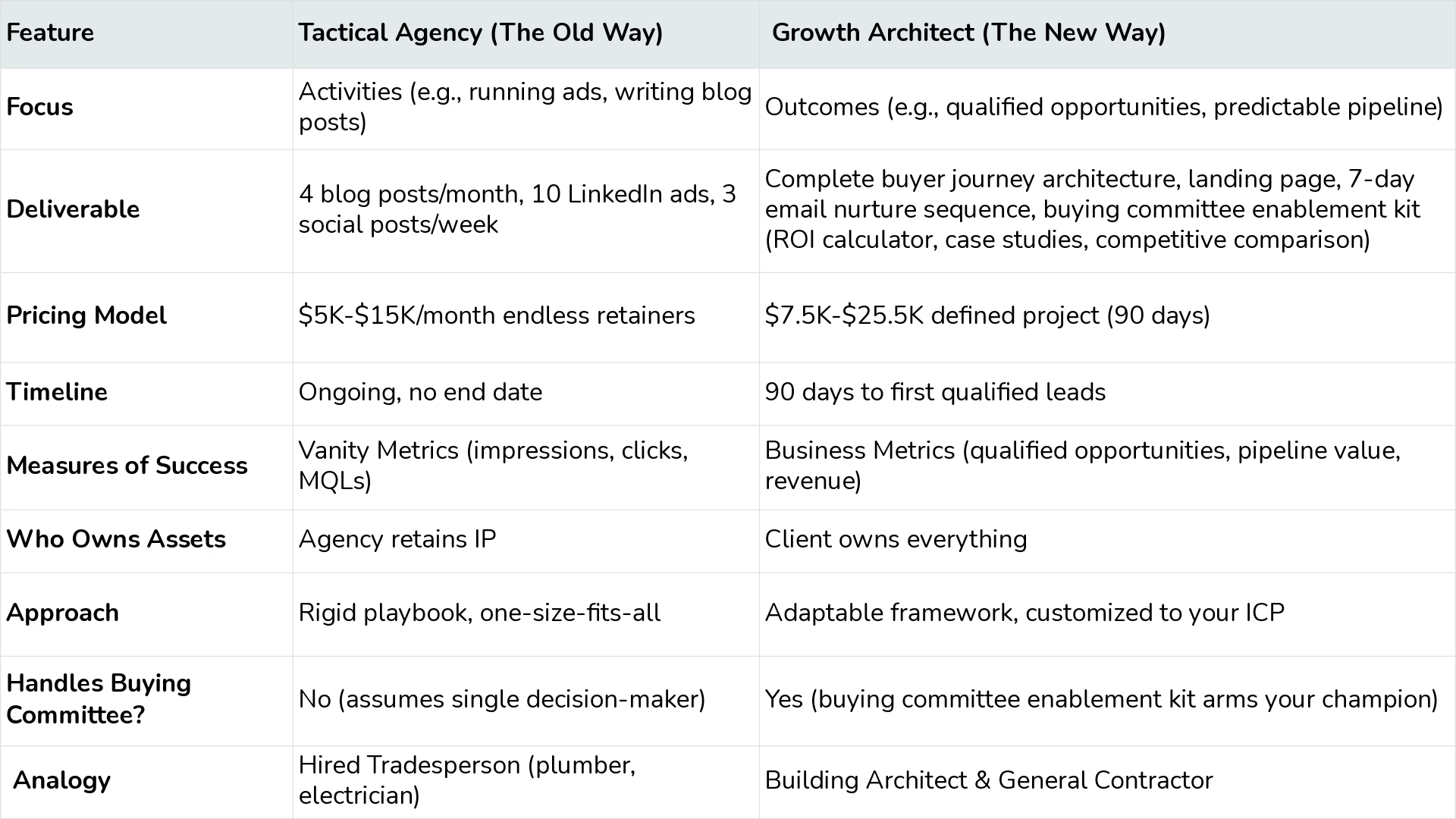
The choice is clear. You can continue to rent the services of tradespeople, paying them every month to lay a few more feet of pipe in an empty field. Or you can invest once in an architect to design the blueprint for a skyscraper that you will own forever.
The payoff for building infrastructure is not just a better process; it’s a dramatically better result. Companies that excel at lead nurturing (the “wiring” in our analogy) generate 50% more sales-ready leads at a 33% lower cost. And B2B companies that build a true content and SEO system (a core part of the “foundation”) see an average 748% ROI over the long term.
Stop buying tactics. Start building infrastructure. It’s the only way to break the Death Spiral and build a predictable, scalable growth engine.
Chapter 5: Rule #2 – Build for the 97%, Not Just the 3%
So you’ve embraced the mindset of a Growth Architect. You’ve committed to building infrastructure, not just buying tactics. You have your blueprint, your foundation, your wiring, and your inspection plan. You’re ready to build.
But who are you building for?
This question leads to the second new rule for growth, and it’s the one that separates companies that achieve linear growth from those that achieve exponential, compounding growth.
Rule #2: Build for the 97%, Not Just the 3%.
Imagine your entire target market is a stadium of 100 people. At any given moment, only three of them are actively looking to buy a solution like yours. They have budget approved, they’re scheduling demos, and they’re ready to make a decision. This is the 3%.
The other 97 people in the stadium are not actively buying. They might be vaguely aware they have a problem, or completely unaware. They might be researching solutions casually, or not at all. They’re busy with their day-to-day jobs, and solving this particular problem isn’t their top priority right now.
The tactical agency you hired in Chapter 1? Their entire business model is built on finding and converting the 3%. They run ads with headlines like “Book a Demo” and “Get a Quote.” They use high-pressure tactics to try to force a decision. And they’re competing with every other agency and every other vendor who is also fighting for the attention of those same three people.
This is the bloodbath. It’s a red ocean of competition where the only way to win is to shout louder, spend more, or discount deeper. It’s a game of diminishing returns, and it’s why customer acquisition costs are always rising.
The Growth Architect understands that the real opportunity isn’t in the 3%. It’s in the 97%.
Why? Because 81% of B2B buyers choose their winning vendor before they ever contact sales. They do their own research. They read articles. They listen to podcasts. They ask their network for recommendations. They spend months, sometimes years, educating themselves and forming an opinion.
By the time they enter the 3% and are ready to buy, they’ve already made up their mind. The sales call is just a formality to confirm their choice.
This is the fundamental flaw in the tactical agency model. They ignore the 97% and then show up at the last minute, trying to win a game that’s already been lost. They’re trying to build a relationship in the final two minutes of a 10-month sales cycle.
Building for the 97% means you stop thinking about “lead generation” and start thinking about “demand creation.” It means you provide so much value, for so long, to so many people in your target market that when they finally are ready to buy, you’re the only logical choice.
This is the difference between renting traffic and owning it.
- Renting Traffic (The 3% Strategy): You pay Google or LinkedIn every month to put your message in front of people who are actively searching. The moment you stop paying, the traffic stops. You’re on a hamster wheel, constantly feeding the machine to get your next hit of leads.
- Owning Traffic (The 97% Strategy): You create valuable assets—articles, guides, podcasts, tools—that attract your ideal customers organically. These assets live on your website, and they work for you 24/7, generating traffic, building trust, and creating demand while you sleep. This is an asset that compounds over time.
This is why Phase 4 of the Predictable Pipeline System is Long-Term Demand Creation. The initial 14-week pilot is designed to build the infrastructure and generate immediate pipeline from the 3%. But the real, sustainable growth comes from what happens next: building a content engine that captures the 97%.
The payoff is staggering. B2B companies that build a true content and SEO system—an engine for the 97%—see an average 748% ROI over the long term. Why? Because they’re not just renting attention; they’re earning it. They’re not just capturing demand; they’re creating it.
Stop fighting over the three people in the stadium who are ready to buy today. Start building a brand that the other 97 will choose tomorrow. That’s how you break the Death Spiral and build a growth engine that lasts.
Chapter 6: Rule #3 – Target the Right Buyers at the Right Time
So you’ve committed to building infrastructure (Rule #1) and you’re building it for the 97% (Rule #2). You’re creating valuable assets, earning trust, and positioning yourself as the only logical choice.
But there’s one final piece of the puzzle. A strategic layer that separates the good from the truly elite.
It’s not enough to build for the right people. You have to reach them at the right time. This leads us to the third and final new rule for growth:
Rule #3: Target the Right Buyers at the Right Time.
Not all prospects are created equal. A CMO who has been in their role for five years is in a completely different mindset than a CMO who started last month. One is focused on maintaining the status quo; the other is looking to make their mark.
Think about your own life. Why do so many people join a gym on January 1st? It’s the Fresh Start Effect. A temporal landmark—a new year, a new month, a birthday—creates a psychological break from the past. It makes us feel disconnected from our past imperfections and gives us a surge of motivation to change.
This same effect happens constantly in the business world. And it’s the single most powerful, yet overlooked, trigger for B2B buying decisions.
- A new executive is hired. They have a mandate to shake things up and a budget to make it happen.
- A company raises a new round of funding. They’re under pressure to deploy that capital and show growth.
- A team moves into a new office. They need new furniture, new IT systems, new everything.
These are all Fresh Start moments. And for a brief window—typically the first 3 to 6 months after the event—these buyers are dramatically more likely to make a major purchase. They are actively looking for new solutions, new partners, and new ways of doing things. They are in a state of “active evaluation,” and they are the lowest-hanging fruit in your entire target market.
The tactical agency you hired in Chapter 1? They don’t know this. They treat every lead the same. They send the same generic message to the five-year veteran and the one-month rookie. They’re wasting 90% of their effort on people who are not in a buying window.
The Growth Architect knows that the most efficient path to revenue is to focus disproportionate effort on Fresh Start prospects. This isn’t a tactic; it’s a core part of the strategy.
This is why Phase 1 (Research) of the Predictable Pipeline System is so critical. We don’t just define your Ideal Customer Profile (ICP). We identify the Fresh Start Signals for that ICP:
- What events trigger a buying decision in your market?
- How can we identify those events in real-time? (e.g., LinkedIn job changes, Crunchbase funding alerts, industry news)
- What messaging will resonate with a buyer in that specific Fresh Start moment?
Then, in Phase 3 (Test), we build campaigns that are laser-focused on these trigger events. Instead of a generic ad that says, “We help companies grow,” we run a hyper-targeted ad that says, “Just started a new CMO role? Here’s the 90-day plan our clients use to make an immediate impact.”
See the difference? The first is a generic message to everyone. The second is a specific solution to a specific person at a specific time.
This is how you cut through the noise. This is how you shorten a 10-month sales cycle. This is how you stop wasting money on prospects who aren’t ready to buy and focus your resources on those who are.
Building infrastructure is the foundation. Building for the 97% is the long-term strategy. But targeting Fresh Start buyers is the accelerator. It’s the secret to generating predictable pipeline, not in a year, but this quarter.
Stop treating all prospects the same. Start targeting the right buyers at the right time. It’s the final key to breaking the Death Spiral and building a growth engine that is not just effective, but ruthlessly efficient.
Conclusion: The Fourth Option
You’re back in your office, staring at the wall. But this time, it’s different. The feeling isn’t dread. It’s clarity.
You now understand the Agency Death Spiral. You see the pattern. You recognize the Siren Song of Tactics. You know that the true culprit isn’t the agency you fired; it’s the role you hired them for. You hired a plumber to build a skyscraper, and you got a lot of expensive pipes leading nowhere.
But now you have the blueprint. You have the new rules for growth:
- Rule #1: Stop Buying Tactics, Start Building Infrastructure. You don’t need another monthly retainer; you need a permanent asset that you own forever.
- Rule #2: Build for the 97%, Not Just the 3%. You don’t need to fight in the bloodbath of the 3%; you need to build a brand that the other 97% will choose when they’re ready.
- Rule #3: Target the Right Buyers at the Right Time. You don’t need to treat all prospects the same; you need to focus your resources on Fresh Start buyers who are in a buying window now.
So what do you do next? As a B2B founder, you have four options.
Option 1: The DIY Approach. You can try to build this infrastructure yourself. You can piece together the systems, write the content, and run the ads. You’ll save money, but you’ll spend your most valuable resource: time. And you’ll likely make a lot of expensive mistakes along the way.
Option 2: The Tactical Agency. You can hire another cheap agency and hope for a different result. You can sign another six-month contract, hand over another $60,000, and find yourself right back in the Death Spiral. As they say, the definition of insanity is doing the same thing over and over and expecting a different result.
Option 3: The Top-Tier Agency. You can hire a massive, top-tier agency that has the strategic depth to build a real system. They’ll do a great job. But they’ll charge you $35,000 a month, and you’ll be locked into a long-term contract. And at the end of it, they’ll still own the keys.
Or, there’s a fourth option.
Option 4: The Growth Architect. You can partner with a firm that will design and build the infrastructure with you, and then hand you the keys. A firm that will give you a defined project with a clear timeline and a guaranteed result. A firm that will build the asset once, so you can own it forever.
This is the new model. This is the way to break the cycle.
If you’re tired of the Death Spiral, if you’re ready to stop renting traffic and start owning it, if you’re ready to build a true foundation for growth, the first step isn’t to hire another agency. It’s to rethink your approach.
Start by asking yourself one simple question:
“Do we have a blueprint, or are we just hiring tradespeople and hoping for the best?”
Your answer will determine your future.