



Why Marketing Agencies Fail: A Systemic Problem
If you’re a B2B founder, you’ve likely asked yourself the frustrating question: why do marketing agencies fail so often? You hire them with high hopes and a significant budget, only to find yourself six months later with a drained bank account, a demotivated sales team, and a pipeline that’s just as empty as when you started. It’s a story so common it has become a painful rite of passage in the tech industry.
This recurring failure isn’t a coincidence or a string of bad luck. It’s a predictable pattern with a name: the Agency Death Spiral. It is the inevitable outcome of a fundamentally flawed, tactics-first model that most B2B companies unknowingly buy into. This comprehensive guide will dissect exactly why marketing agencies fail, help you diagnose the four predictable stages of this spiral, and provide a clear blueprint to break the cycle for good.
The Core Reason for Failure: Tactics Over Strategy
The single biggest reason why marketing agencies fail is a profound misalignment of business models. Most founders, under immense pressure to generate leads, hire agencies to execute a list of tactics—run Google ads, write SEO blog posts, manage a social media calendar. They purchase a menu of services, believing that this activity will magically coalesce into a coherent strategy. It never does.
The Allure of the Tactical Agency: A Short-Term Solution
Why do so many smart founders fall into this trap? Because in a world of overwhelming complexity, tactics feel simple and safe. After enduring confusing sales calls with “strategic consultants” who speak in abstract buzzwords, the tactical agency that promises “50 MQLs a month for $10k” feels like a lifeline. Their proposal is a concrete, tangible menu of deliverables. It feels like you are buying action and certainty.
This is the Siren Song of Tactics. It’s alluring because it promises a simple, transactional solution to what is actually a deep, systemic problem. But it’s a trap, and by answering its call, you take your first unwitting step into the Agency Death Spiral.
The Architect vs. The Plumber: A Fundamental Misunderstanding
Imagine you want to build a revenue-generating skyscraper. Instead of hiring an architect to create the master blueprint, you hire a plumber. The plumber is excellent at their job. They show up and immediately start laying pipes. They work diligently and send you weekly reports on the footage of pipe laid. After a few months, you have a world-class plumbing system sitting in the middle of an empty field.
But you don’t have a skyscraper. You have no foundation, no electrical, no structural engineering. Would you blame the plumber? Of course not. You hired a plumber; you got plumbing. This is the mistake founders make. They hire tactical agencies—the plumbers, electricians, and drywallers of the marketing world—and expect them to be the architect. A tactical agency is a specialist who executes a task. A growth architect is a strategist who designs the entire system. This is the most common reason why marketing agencies fail: they are hired for a job they were never designed to do.
The 4 Predictable Stages of the Agency Death Spiral
This failure isn’t a sudden implosion. It’s a slow, creeping decay that unfolds in four predictable stages. Recognizing this pattern is the first step to escaping it.
Stage 1: The Hopeful Honeymoon & The Retainer Trap
The first one to two months are filled with relief and optimism. The kickoff call is energetic, the agency team is sharp, and their 90-day plan is packed with deliverables. You feel a weight lift from your shoulders; you’ve finally delegated the marketing problem. You’re paying for the feeling of being taken care of, and for a short time, it feels worth every penny. This is the Hopeful Honeymoon, a period of blissful ignorance where activity is mistaken for progress. It’s also the first sign of why marketing agencies fail—the commercial relationship is based on activity, not outcomes.
Stage 2: The Vanity Metric Mirage
Why Metrics Look Good But Revenue Doesn’t
Around months two to four, the first performance reports arrive. The dashboards are a sea of green: impressions are up 300%, clicks are up 150%, and you have a flood of new Marketing Qualified Leads (MQLs). However, your sales team’s pipeline remains stubbornly flat. The agency is measuring what’s easy to measure (vanity metrics), not what actually matters (qualified opportunities, pipeline velocity, revenue). This growing disconnect between the agency’s dashboard and your company’s bank account is a classic symptom of a failing agency relationship.
Stage 3: The Sales Team’s Revolt
When Sales and Marketing Stop Talking
By months four to five, the situation deteriorates into internal conflict. Your sales team, frustrated with chasing low-quality MQLs, has stopped following up on the agency’s leads altogether. They’ve created a new lead status in your CRM: “Marketing Garbage.” You attempt to broker a peace treaty in a tense meeting. The agency defends its MQL numbers, suggesting your sales team isn’t aggressive enough. Your head of sales, in turn, accuses the agency of delivering useless names on a spreadsheet. You are caught in the middle, funding a civil war between two departments while your growth stalls.
Stage 4: The Blame Game & Inevitable Churn
The Accountability Gap
At the six-month mark, the end is near. You’ve spent $60,000 with zero new revenue to show for it. On the final review call, the agency deploys its pre-rehearsed defenses: “Your sales cycle is long,” “The market is tough,” “We’re building brand awareness.” They deflect, shift blame, and hide behind the complexity of marketing. It’s in this moment you realize they have no skin in the game. They get paid for activity, not results. You terminate the contract, angry and disillusioned. You’ve just learned the hard way why marketing agencies fail, and you’re back at square one.
The Antidote: How to Avoid Failure by Building Growth Infrastructure
If the traditional agency model is broken, what is the alternative? The solution is to make a fundamental mindset shift: stop renting tactics and start owning your growth infrastructure. This is the guiding principle of a Growth Architecture Firm.
What is Growth Infrastructure?
The Four Pillars of a Revenue Engine
Instead of hiring an agency to perform a list of recurring tasks, you partner with a firm to design and build a complete, permanent revenue engine that you own. This is a one-time project to create a long-term asset. This system has several core components:
The Blueprint: Buyer Journey Architecture
This is the master plan for your entire marketing and sales process. It maps every stage of your customer’s journey, from initial awareness to the final purchase decision, dictating the right message to be delivered at the right time.
The Foundation: Positioning & Messaging
This is the core narrative that separates you from the noise of the market. It’s the story you tell and the unique space you occupy in your customer’s mind. Without a strong foundation, even the best tactics will fail.
The financial and strategic difference between these two models is stark. When you rent tactics from an agency, the work stops the moment you stop paying. You are on a hamster wheel, perpetually feeding the machine. When you build infrastructure, you create an asset that appreciates over time. The content, the systems, and the data you own continue to generate traffic, trust, and opportunities long after the initial investment, delivering compounding returns.
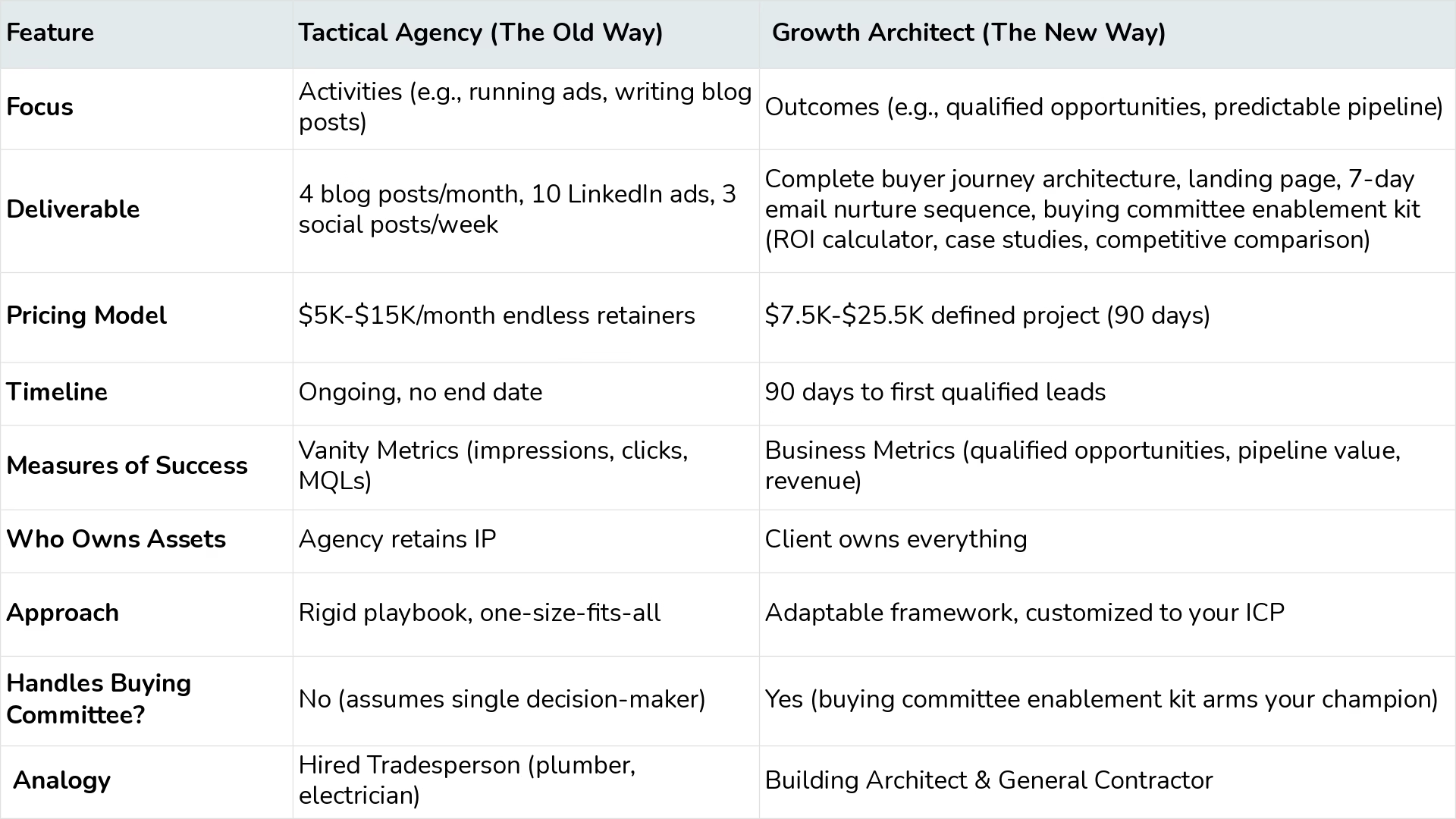
The Three New Rules for Breaking the Cycle
Escaping the Death Spiral requires adopting a new set of principles that prioritize long-term asset creation over short-term activity.
Rule #1: Stop Buying Tactics, Start Building Infrastructure. Your goal is not to find a better agency to run your ads; it is to build the underlying system that makes all ads more effective. Invest in the blueprint before you hire the tradespeople.
Rule #2: Build for the 97%, Not Just the 3%. At any moment, only 3% of your market is actively buying. Tactical agencies fight a bloody battle for this 3%. A Growth Architect builds a system to educate and earn the trust of the other 97% who are not yet ready to buy. By the time they are ready, you are the only logical choice.
Rule #3: Target the Right Buyers at the Right Time. Within the 97%, the most valuable prospects are those experiencing a “Fresh Start Effect”—a new job, a new round of funding, a new strategic initiative. These buyers are dramatically more likely to make a major purchase. A growth architecture system is designed to identify these trigger events and target these buyers with a specific, relevant message at the perfect time.
Conclusion: You Don’t Have an Agency Problem, You Have a Model Problem
The reason why marketing agencies fail so consistently is not because their practitioners are incompetent. It is because they are being hired to solve a strategic problem with a tactical solution. You cannot expect a plumber to be an architect.
To break the cycle, you must change your approach. Stop asking, “Which agency should I hire?” and start asking, “What is the blueprint for our growth engine?” The answer to the latter question will lead you away from the endless cycle of the Agency Death Spiral and toward a future of predictable, scalable, and ownable growth.
Ready to build your blueprint?
Book a 30-minute strategy call. We’ll evaluate your current revenue system, identify the critical gaps, and show you the path to a predictable pipeline. No pressure. No hard pitch. Just clarity.